
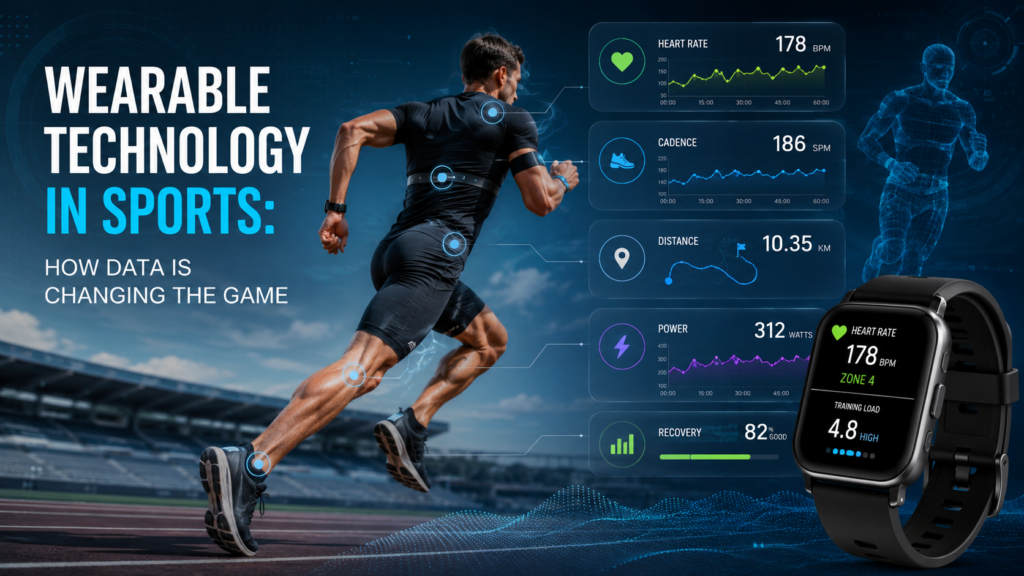
Modern sports are more demanding than ever. Athletes are pushed to run faster, recover quicker, and sustain peak performance across longer seasons — all while operating in increasingly competitive environments where margins between winning and losing are razor-thin. In this landscape, raw talent alone is rarely enough. What separates elite performers from the rest is often their ability to understand and manage their own bodies with precision. That’s exactly where wearable technology comes in.
What Are Wearables?
Wearables are electronic devices worn on or close to the body that continuously collect physiological and biomechanical data. For athletes, they serve as a real-time window into everything the body is doing — and everything it might be struggling with. These devices track metrics such as heart rate, movement patterns, distance covered, calories burned, sleep quality, muscle strain, and recovery status.
Common examples include:
- smartwatches and fitness bands
- heart rate monitors
- GPS trackers
- motion sensors
- smart mouthguards
- biosensor skin patches
- compression garments with embedded sensors
Most are worn on the wrist, chest, or head, though many are now integrated directly into athletic clothing — making them nearly invisible during competition.
Technology Doesn’t Stop at the Stadium
The data revolution that transformed elite sport didn’t stay confined to training grounds and locker rooms. The same technological momentum — real-time analytics, AI-driven personalisation, seamless digital interfaces — spread into how people spend their leisure time. And leisure, of course, takes many forms.
One of the most significant transformations has happened in the world of casino gaming. What was once a purely physical experience — the casino floor, the dealer, the felt table — has been rebuilt from the ground up by technology. Today’s online casinos use sophisticated random number generators audited for statistical fairness, live-dealer streaming with sub-second latency that replicates the atmosphere of a real table, and AI systems that detect problem gambling patterns and intervene proactively. Facial recognition and biometric verification have replaced ID checks at the door. Some platforms now use machine learning to personalise game recommendations the same way streaming services suggest content — based on behaviour, session length, and playing style.
The live casino format deserves particular attention. Platforms like Parimatch casino offer live blackjack, roulette, and baccarat streamed in real time from professional studios, with human dealers and multiple camera angles. The experience is closer to broadcast television than to the online gaming of a decade ago. Players can interact with dealers via chat, switch table limits mid-session, and access game history statistics in real time — tools that would have been unimaginable in a brick-and-mortar setting.
Even game design itself has changed. Provably fair technology — based on cryptographic algorithms — allows players to independently verify that each outcome was genuinely random, something no physical casino could ever offer. It’s a level of transparency that reflects just how seriously the industry has had to adapt to a more informed, more data-literate audience.
Why Wearables Matter in Sport
Training Control Overtraining is one of the most common — and underestimated — risks in professional sport. Wearables give athletes and coaching staff an objective basis for decisions: when to push intensity, when to hold back, and when the body genuinely needs rest. This removes guesswork from periodisation and helps structure training around actual recovery data rather than assumption.
Health Monitoring Continuous tracking of vital signs means that abnormalities — elevated resting heart rate, signs of chronic fatigue, disrupted sleep cycles — are caught early, before they develop into something serious. For teams managing large rosters across a long season, this kind of proactive monitoring is invaluable.
Injury Prevention By identifying stress accumulation and movement imbalances before they cause damage, wearables have become a core part of injury management. Coaches can adjust training loads based on real data, and athletes return from injury with measurable benchmarks rather than subjective assessments of how they “feel.”
Emergency Response In cases of sudden on-field incidents — cardiac events, acute injury, dangerous physiological readings — wearables can alert medical staff immediately. The ability to respond within seconds rather than minutes can be genuinely life-saving.
Performance Optimisation Beyond health and safety, wearables build a long-term performance record. A sprinter can track speed progression week over week; a midfielder can analyse how their output changes across a 90-minute match. This longitudinal data becomes a feedback loop — informing strategy, refining technique, and compounding small gains into significant improvements over a season.
Final Thoughts
Wearable technology has moved from innovation to infrastructure. In elite sport today, the question isn’t whether athletes use these tools — it’s how well they use them. The broader lesson is the same across every field technology touches: when data replaces guesswork, the experience — whether training, competing, or simply unwinding — becomes sharper, safer, and more engaging.

